
Dubai has evolved beyond being a transitional market.
Due to luxurious amenities and high demand from high net worth individuals, branded residences in Dubai can yield twice the rental income compared to non-branded residences.
According to industry executives, luxury and branded homes also exhibit a greater potential for price appreciation compared to other segments of the market.
Dubai is no longer considered a transitional market, as it attracts high-net-worth individual buyers who are choosing to establish a more permanent presence. This shift indicates the maturation of the real estate market in the region.
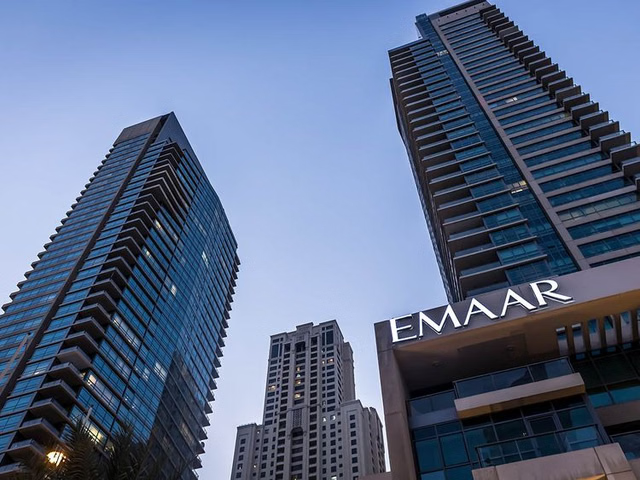
According to Lewis Allsopp, chairman of Allsopp & Allsopp, there is a consensus among investors, landlords, and tenants regarding the premium rental rates for high-quality ‘branded residences.’ These modern and well-designed living spaces, situated in desirable residential buildings, offer luxurious amenities and can command rents up to 100% higher than comparable ‘non-branded’ units in the same locations.
To meet the growing demand from the world’s affluent individuals flocking to the emirate, Dubai has witnessed numerous launches of branded residences in recent years, securing its position as the leading global destination for such developments. Local developers like Binghatti Properties, Danube Properties, RSG Group, Rove, and others have capitalized on this demand by introducing their own branded residences.
Last week, Binghatti Properties unveiled its third branded project, Mercedes-Benz Places, following Bugatti Residences and Burj Binghatti Jacob & Co. Similarly, Danube Properties collaborated with Fashion TV to introduce Fashionz by Danube, featuring over 700 apartments spread across 65 floors.

Buyers coming to Dubai for quality
Over the last two or three years following the Covid lockdowns, high-net-worth buyers have been migrating from continental European countries such as the UK, France, and Germany to settle in Dubai. This trend is partly driven by the absence of real estate tax in Dubai, resulting in a surge in property prices.
Chris Whitehead, the managing partner at Dubai Sotheby’s International Realty, highlighted that buyers are attracted to Dubai for its property quality, value for money, cleanliness, and retail offerings. Traditionally, Dubai was viewed as a transient location where people came to earn money and then returned to their home countries. However, the current trend shows that many individuals are now choosing to move to Dubai for the lifestyle and are opting to stay.
In the previous year, Dubai witnessed record-breaking sale prices, with super-luxury residences fetching prices of up to $4,000 (Dh14,692) per square foot. This marks consecutive year-over-year increases in sale prices since 2020.