Despite the ongoing prosperity of Dubai’s luxury property market, the mid-market is emerging as an essential and swiftly expanding sector.
Dubai’s real estate sector has long been associated with luxury, but a change is on the horizon. The mid-market segment is rising as the quickest growing and most sought-after sector, possibly posing a challenge to the dominance of the luxury market.
“Historically, Dubai’s real estate market concentrated on upscale residences for the wealthy, but presently, there is an increase in more accessible choices for the average working professional,” remarked Anna Skigin, CEO of Frank Porter, in a special interview with Arabian Business.
John Lyons, Managing Director of ESPACE, contended that the mid-market doesn’t have to compete with the luxury market for dominance. “It has consistently been the more sought-after market, despite not garnering as much media attention,” he stated.
He emphasized that the mid-market segment “remains, and will always remain, the most rapidly growing and sought-after sector of Dubai’s real estate market.”
As per a recent analysis by Knight Frank, the total value of luxury homes sold in Dubai during the first quarter of 2024 exceeded $1.7 billion, marking a 6 percent increase compared to the same period in 2023.
“This increase indicates a promising outlook for the city’s real estate sector. From branded residences to waterfront estates, luxury properties have predominantly been acquired by investors from the United Kingdom, Russia, and China, attracted by the emirate’s appealing lifestyle and favorable tax policies,” stated Gul Tabba, Developer at Lucky Aeon Real Estate Development.
He acknowledges a recent change in the market, remarking, “Luxury’s long reign in Dubai’s real estate sector is waning, with buyers increasingly prioritizing value and refusing to compromise on quality. This has led to the emergence of the flourishing mid-market segment.”
Earlier this year, Arabian Business highlighted the necessity for Dubai to increase its mid-market property offerings to attract a wider range of investors, aligning with the city’s Urban Master Plan 2040 aimed at accommodating its growing population.
Despite having more than $356 billion allocated to private real estate developments and ongoing public building and housing programs, this anticipated demand persists.
“Dubai’s Urban Master Plan for 2040 anticipates a population of 7.8 million by that year. With the city’s demographics continuing to expand and diversify, demand will increase, necessitating developers to introduce new projects catering to a broader range of budgets,” stated Lyons.
“The emphasis lies in affordability, as historical data indicates that over 60 percent of purchases fall below AED3 million, underscoring the importance of introducing high-quality mid-market developments,” he emphasized.
According to Deloitte’s latest Middle East Market Predictions Report 2024, “The residential market has experienced a consistent upward trend, characterized by record transaction levels in 2023, along with an 18 percent and 26 percent year-on-year increase in sales prices and rents respectively.”
Top areas for sales price growth
- Palm Jumeirah (apartments)
- Dubai South
- Mohammed Bin Rashid (MBR) City
The data indicates that last year, the secondary market constituted more than 41 percent of transactions, with areas like Business Bay, Downtown Dubai, and Jumeirah Village Circle (JVC) witnessing the highest transaction volumes.
The report affirms that cash buyers continue to dominate the Dubai property market, particularly in the affordable villas and townhouses segment, driving market activity.
Skigin cited research by Visual Capitalist, noting the global growth of the middle class, with over 110 million individuals expected to join this segment this year.
“As Dubai enhances its business and tourism offerings, the need for accommodation for those contributing to the city’s growth will persist,” she emphasized, advocating for the mid-market.
Lyons provided context, highlighting that in Q1 of this year, the number of properties sold in the 2 to 5 million price range was 500 percent higher than those sold in the over 10 million price range in the residential market.
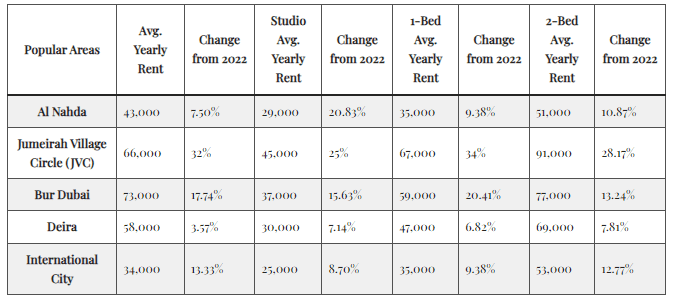
Moreover, according to experts, the mid-market sector offers attractive opportunities for investors seeking profitable rental returns. This affirmation is supported by Dubizzle’s 2023 Annual Property Rental Market Report, which highlights the potential in areas like Jumeirah Village Circle. For instance, the report indicates a remarkable 32 percent surge in average annual rents, escalating from 50,000 in 2022 to 66,000 in 2023. This trend underscores the growing demand for rental properties in such communities, making them appealing targets for investors looking to capitalize on rental income.
Most popular areas for renting affordable properties in Dubai
Skigin noted that Dubai’s mid-market growth is further propelled by the favorable environment for sole traders and small business owners to establish themselves. The emirate’s support for entrepreneurship attracts the middle classes, fostering stronger connections with Dubai. As these residents launch businesses, they increasingly consider long-term settlement plans. With rental prices and interest rates remaining high, purchasing property becomes even more appealing.
While the luxury property market is booming with the introduction of various branded residences, this has also priced out many individuals who now seek more mid-market options.
Adapting to a growing population
As Dubai experiences population growth, it extends its boundaries to accommodate the diverse and expanding populace’s housing requirements. The introduction of more affordable residential units and the swift adoption of properties in emerging neighborhoods indicate a noticeable demand for mid-market housing.
“The city’s expansion is driven by the influx of individuals entering the market, many of whom aren’t specifically seeking luxury residences,” clarified Skigin.
The UAE government persists in enhancing housing accessibility, implementing initiatives such as Golden Visas and retirement programs. These efforts have attracted a wider range of investors and residents.
Although Dubai’s luxury real estate sector continues to flourish, the mid-market segment is emerging as increasingly crucial and rapidly expanding. With continuous developments, government incentives, and evolving demographics, the mid-market is on a positive trajectory.
Lyons emphasized that achieving population growth targets relies on continuous development and rapid expansion of the mid-market, which enhances Dubai’s accessibility and affordability for work and lifestyle opportunities.