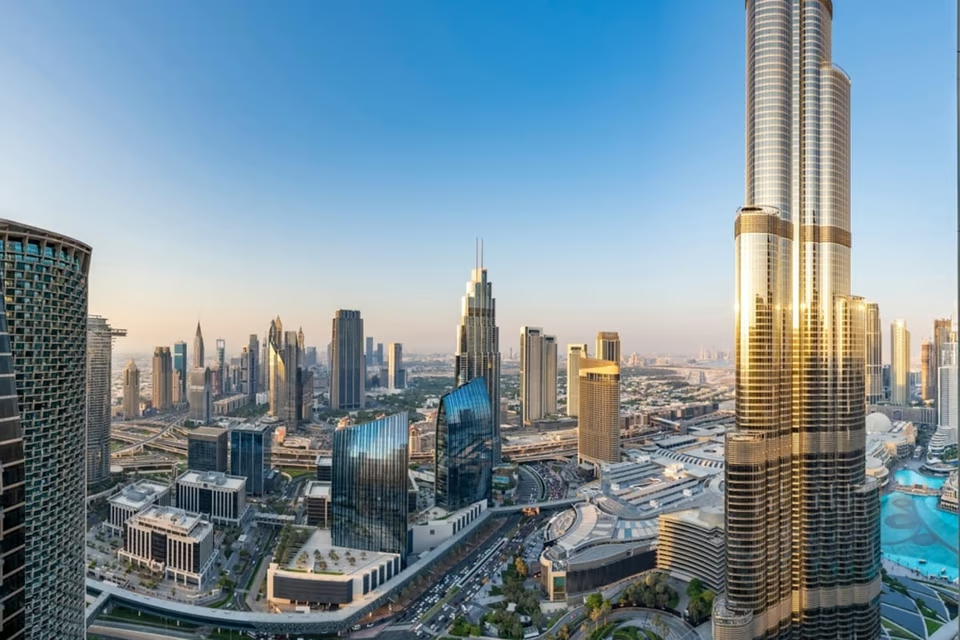
Dubai’s real estate market has experienced three growth cycles, but it underwent two boom-bust periods – first during the 2008 global financial crisis when the market crashed for the first time, and again during the pandemic.
After a three-and-a-half-year rally, industry experts are optimistic that the market will avoid another bust and instead experience slower, steadier growth. This is attributed to the presence of more end-users and serious investors who are committed to investing in the local market.
Dubai’s real estate market has experienced three growth cycles, with two of them characterized by boom-bust phases. As the third cycle concludes, experts believe that the boom-bust phenomenon will not recur. This confidence is attributed to key initiatives such as the establishment of escrow accounts, the influx of millionaires, and the growing number of end-users, all of which have contributed to market stability.
Industry experts suggest that the property market has outgrown the boom-bust cycles, evolving into a more mature and regulated sector.
“Dubai’s real estate market has undergone significant evolution over the years, shifting from past boom-bust cycles to a more stable and sustainable growth path. This maturity is attributed to several factors, including the implementation of stringent regulatory frameworks, enhanced transparency, and a strategic emphasis on long-term economic diversification,” stated Hassan Hijazi, group CFO of Amwaj Development.
He further noted that Dubai’s attractiveness to a diverse range of investors has expanded. According to him, high-net-worth individuals, institutional investors, and expatriates are all drawn to the city’s world-class infrastructure, strategic geographic location, and innovative developments.
“The Expo 2020 legacy and various government initiatives, including the Golden Visa programme, have significantly contributed to attracting and retaining investors, solidifying Dubai’s status as a global investment hub,” noted Hijazi.
Imran Farooq, CEO of Samana Developers, remarked that over the past five decades, Dubai has developed a robust economic infrastructure and a diverse multinational society, making it incorrect to describe the city’s rise as “artificial or a bubble.”
“The city is firmly established on strong foundations. Dubai has demonstrated its capabilities to the world by successfully hosting global events like Dubai Expo 2020 and UAE COP28, as well as its exemplary management of the Covid-19 pandemic. It is only logical that Dubai’s real estate sector has matured and moved beyond the boom-and-bust cycle,” Farooq said.
Yogesh Bulchandani, founder and CEO of Sunrise Capital, observed that for those who have witnessed the sector’s fluctuations, it is evident that Dubai’s real estate market has shown remarkable resilience, defying predictions of a slowdown.
“While global property markets falter, Dubai’s property prices continue to rise, signaling a deviation from the typical boom-and-bust cycles. This strength is supported by buyers purchasing properties for occupancy, suggesting a shift away from Dubai’s previously transient nature. Demand remains strong from Europe (including the UK), India, and South Asia, with an influx of wealthy investors and foreign buyers contributing to a more stable and mature real estate market in Dubai,” he emphasized.
The CEO of Samana Developers stated he does not anticipate a drop in Dubai property prices over the next five years, attributing this to the attractive returns for investors.
“We have observed an increase in investors from Europe, the CIS, and China. All market segments are experiencing high demand. Higher prices make the market appealing to foreign institutional investors, further strengthening Dubai’s real estate sector and benefiting all stakeholders,” he added.
Dubai’s relatively lower property prices compared to cities like Hong Kong, Singapore, and New York draw investors but don’t guarantee immunity from fluctuations, according to Bulchandani.
“The current trend of sustained price increases might indicate maturity, but global economic interconnections and investor behavior still pose risks of cyclical trends,” he emphasized.
Meanwhile, Hassan Hijazi pointed out that Dubai’s relatively lower property prices compared to cities like Hong Kong, Singapore, and New York provide a buffer against significant market corrections.
“This affordability, along with the city’s continuous development, safety, quality of life, and proactive government measures, makes Dubai’s property market appealing to a wide range of investors and residents.
“Additionally, the government’s proactive measures to regulate supply and demand dynamics ensure market stability. While some price adjustments are natural in any real estate cycle, the inherent value proposition of Dubai’s property market positions it well to avoid major corrections, ensuring sustained investor confidence and market resilience,” said Hijazi.