The UAE’s liberal migration policies are central to sustaining the growth of Dubai’s real estate market, an expert highlighted.
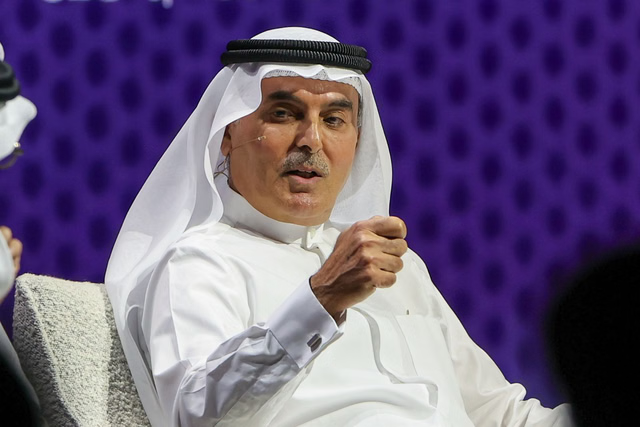
“Dubai’s allure is unmistakable, with entrepreneurs, investors, high-net-worth individuals (HNWIs), and ultra-HNWIs (UHNWIs) from around the world gravitating toward the city. Legislative reforms, long-term residency options, tax benefits, and business-friendly policies have positioned Dubai as a top choice for global capital. The city’s outstanding infrastructure, healthcare, education, and lifestyle add to its appeal, making it a haven for the world’s affluent,” said Abdullah Alajaji, CEO of Driven Properties, in an interview with Khaleej Times.
Like Madrid and Miami, Dubai’s success is built on favorable migration and economic policies, Alajaji pointed out. “These cities have become safe havens for wealthy individuals seeking financial security and high quality of life. By contrast, cities like London, Hong Kong, and Berlin have faced setbacks due to policy changes and uncertain market conditions,” he added.
Supply levels in Dubai’s real estate market are a key focus. “While demand remains strong, supply is carefully managed. Some major projects, such as the ambitious Jumeirah Central development originally planned near the Mall of The Emirates, have been shelved. Meanwhile, projects like Palm Jebel Ali are progressing, supported by initiatives like the Al Maktoum Airport expansion and Dubai’s population growth projections. In the north, Dubai Islands are advancing, with developers preparing to announce new plans,” Alajaji noted.
Land remains widely available towards the emirate’s east, yet careful control over supply is essential to prevent market oversaturation, Alajaji remarked. “This measured approach is crucial for maintaining Dubai’s real estate sector’s appeal to global investors,” he added.
Alajaji referred to the “Golden Square” — a term used at Driven to define the prime area from Port De La Mer to Jumeirah Bay Island, encompassing the Peninsula, a new ultra-luxury island, Downtown, Jumeirah Water Canal, and City Walk. “With landmarks like DIFC and the upcoming DIFC 2.0, this area will be a focal point of Dubai’s premium real estate,” he added.
The decision by Dubai’s mega-developers to delay or downscale some large projects reflects a commitment to keeping the market stable. This shift towards managed, strategic growth bodes well for the city’s future, the Driven CEO noted.
Recent trends indicate that, for the first time in several quarters, Dubai’s secondary real estate market is surpassing the primary market in both transaction volume and value, marking the market’s maturity and rising value of existing properties.
“At Driven, we monitor population density closely as a significant indicator of long-term real estate potential. Dubai’s current density is 727 people per square kilometer, much lower than Singapore (7,500 people per square kilometer) and New York City (over 10,000 people per square kilometer). As Dubai follows its 2040 Urban Plan and releases new inventory carefully, the market will only strengthen,” Alajaji said.
Dubai’s Real Estate Cycles: Growth and Adjustment
Dubai’s real estate market has undergone defined cycles of growth and adjustment over the years:
– 2000-2008: Freehold laws allowing foreign ownership drive exponential growth.
– 2009-2011: The global financial crisis impacts Dubai.
– 2012-2014: Economic recovery triggers another market upswing.
– 2015-2020: A period of adjustment and stabilization.
– 2021-2024: Rapid expansion and growth characterize the market.
– 2025-2040: Strategic growth is anticipated to consolidate gains.
Despite rising prices, Dubai is still among the most affordable luxury markets worldwide. Bloomberg recently identified Dubai as the world’s best-performing real estate market, with high yields presenting a prime buying opportunity. Property price-to-earnings ratios remain below pre-Covid levels, offering significant potential for growth.
On the global stage, conditions are shifting favorably for Dubai. “Expected interest rate cuts by the US Federal Reserve, anticipated to begin this September, will ease money markets globally, boosting Dubai’s real estate and alternative assets,” Alajaji noted.
As demand continues to exceed supply, Dubai is preparing to unveil several ultra-luxury projects:
– Peninsula Projects: Located along the Jumeirah coast, these branded residences and luxury hotels (Aman and Rosewood) will redefine waterfront living.
– Cheval Blanc Island: Poised to be Dubai’s most exclusive address, offering unmatched luxury living.
– Discovery Dunes: This US-developed golf course community will feature expansive mansions and luxury amenities.
– Bureau Lamar: Addressing the demand for premium office space, this Business Bay development will offer sustainable, luxury offices with waterfront views.
These projects, alongside Dubai’s strategic infrastructure investments, ensure the city’s real estate market remains a global hotspot for the future.
“As demand continues to outstrip supply, investors should act now to leverage Dubai’s unique position. With the intersection of global capital, controlled supply, and robust growth, Dubai’s real estate market presents unmatched investment opportunities,” Alajaji concluded.