Demand for houses in Dubai continues to rise, pushing market prices higher, with a rapid increase in the number of properties valued at over $1 million, according to a new report.
House prices in Dubai are now 19.9 per cent higher than they were a year ago and are projected to grow by another 8 per cent next year, according to Knight Frank’s Dubai Residential Market Review report released on Wednesday.
“Prices are being driven by relentless demand,” said Faisal Durrani, partner and head of research for Mena at Knight Frank. “Of the 530,000 homes sold since 2002, our analysis reveals that 95,000 are now valued at over $1 million, with a combined value of Dh822 billion ($223.8 billion).
“What is remarkable, however, is the pace at which the number of homes valued at over $1 million has increased, rising from just 6.3 per cent of all sales in 2020 to 18.1 per cent today. This means nearly one in every five homes in Dubai is now worth over $1 million,” Mr. Durrani added.
The total value of all homes sold in Dubai since 2002 has reached Dh1.47 trillion, representing a 221 per cent increase since 2020, the report said.
Knight Frank also tracked the historical price changes of homes, identifying “accidental millionaires” – property owners who initially bought units for less than $1 million, which have now surpassed that threshold due to price inflation. Only properties that have not changed ownership were included in this analysis.
Dubai’s residential market continues to expand, with transaction numbers rising by 41.8 per cent year-on-year, reaching a record 47,269 transactions in the third quarter, the highest quarterly figure to date, the report added.
Between January and September, 121,978 home sales were registered, exceeding the total transactions recorded for the entirety of last year. The total value of deals during this period reached Dh306.3 billion, reflecting a 36 per cent year-on-year increase, with Dh116.8 billion recorded in the third quarter alone.
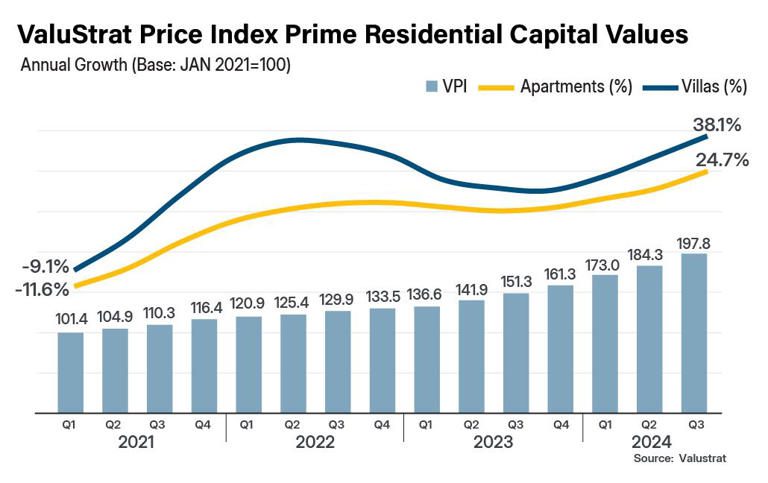
“Mainstream market prices continue to rise, increasing by 4.3 per cent in Q3, which has brought citywide prices 19.9 per cent higher than this time last year, partly due to a decline in the number of homes available for sale,” said Mr. Durrani.
“Property listings across the city have decreased by 30 per cent year-on-year.”
Demand for luxury homes has notably increased, with sales tripling over the last 18 months, resulting in nearly one in five listed homes being sold between June and September, he added.
Dubai’s property market remains robust, supported by new government measures such as residency permits for retirees and remote workers, along with overall economic growth.
Average residential prices in Dubai climbed by around 20 per cent in Q3 compared to the previous year, with apartment prices rising by 19 per cent and villa prices increasing by 23 per cent, according to a CBRE report.
Between January and September 2024, residential transactions in Dubai surpassed 125,000, representing a 36 per cent rise compared to the same period last year, while the total value of deals increased by 34 per cent to Dh314 billion, the report noted.
To address rising demand, nearly 300,000 new homes are expected to be delivered across Dubai by the end of 2029, with apartments accounting for 80.1 per cent of this supply, Knight Frank reported.
However, the villa shortage is likely to continue, with only 8,900 new villas expected by the end of 2024 and another 19,700 by the end of 2025.
“The scarcity of sites in prime locations is also driving up off-plan home prices, while the secondary market is seeing substantial price growth, especially for refurbished older properties,” said Petri Mannila, partner – head of prime residential UAE at Knight Frank.
“The limited availability of development sites and homes for sale, both off-plan and ready, is widening the gap between the city’s prime areas and other parts of Dubai.”
The report highlighted key risks to the market, including a potential global economic slowdown, oil price fluctuations, and growing regional competition.
Looking ahead, while prices are expected to continue increasing, the growth rate is likely to slow next year after nearly five years of steady gains, Mr. Durrani stated.
For Dubai’s prime residential market, growth in 2025 is projected to be more moderate, around 5 per cent, building on the 44.4 per cent growth in 2022 and the 16.3 per cent increase last year, he added.