Dubai’s Rental Market Transforms Amid Regulatory Changes
Dubai’s residential rental market is evolving rapidly, influenced by shifting tenant expectations, policy updates, and broader economic trends. With affordability and flexibility becoming key priorities, industry leaders are adjusting to changing consumer needs and a dynamic real estate landscape.
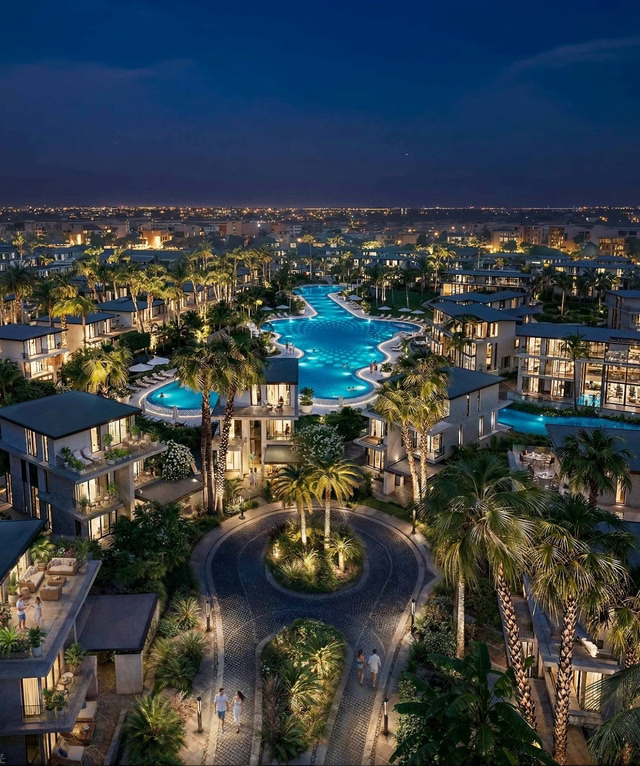
“Over recent years, we’ve observed a clear move toward community-focused living,” stated Ahmed Al Suwaidi, Managing Director of Residential Communities at Dubai Holding Asset Management, in an exclusive conversation with Arabian Business.
“Residents today seek more than just a residence—they look for lively, amenity-rich communities that complement their lifestyles,” he added.
The Rise of Community-Centric Living
This shift aligns with the UAE’s 2025 Year of Community initiative, underscoring the government’s efforts to foster stronger, more connected neighborhoods. Dubai Residential organized over 85 community-focused events in 2024, engaging over 50,000 residents through cultural festivals, sustainability campaigns, and family-friendly gatherings.
From sports facilities to retail hubs, the emphasis is on holistic living experiences that blend convenience with connectivity. “Location is no longer the sole factor,” Al Suwaidi noted. “It’s about lifestyle, accessibility, and the overall experience of being part of a well-planned, vibrant community.”
Changing Rental Preferences in Dubai
Flexibility in leasing has become a top priority for tenants, with increasing demand for adaptable payment structures and lease terms. “Renters now prioritize financial convenience,” Al Suwaidi explained. “Many are willing to pay a premium for flexible options such as multiple cheque payments, short-term leases, and digital transactions.”
Additionally, properties near metro stations, business hubs, and schools continue to attract strong demand, reinforcing the need for strategic real estate development.
Impact of Recent Regulatory Changes
Policy shifts have also significantly influenced Dubai’s rental landscape. “These changes have raised upfront costs, prompting many potential buyers to reconsider homeownership and opt for renting instead,” Al Suwaidi stated.
While the full impact of these regulations is yet to be seen, he anticipates a rise in leasing demand as buyers explore their financing options. “Dubai Residential is well-positioned to accommodate this shift,” he added.
Freehold Ownership and Investor Confidence
New freehold ownership laws are expanding investment opportunities for foreign buyers, boosting confidence in the market. “These regulatory updates will drive large-scale redevelopment and elevate project quality, drawing both local and international investors,” Al Suwaidi remarked.
Despite some tenants transitioning into homeownership, the rental market is expected to remain robust, supported by Dubai’s growing expatriate community and the financial advantages of renting. “For many, renting offers lower initial costs, greater mobility, and access to prime locations without long-term commitments,” he noted.
The latest updates to the RERA rental index have introduced more precise rent benchmarks by incorporating real-time transaction data. “This marks a significant improvement for both landlords and tenants,” Al Suwaidi said. “It ensures fair pricing and strengthens market stability.”
Dubai Residential has embraced these enhancements, leveraging data-driven insights to maintain balanced rental pricing across its extensive portfolio, which includes both premium and budget-friendly housing.
The Integration of Nakheel and Meydan
A major development in the market has been the consolidation of Nakheel and Meydan assets under Dubai Holding. “This integration has positioned Dubai Residential as one of the largest residential leasing portfolios in the city,” Al Suwaidi emphasized. “With over 35,000 units and a community of 140,000 residents, we are uniquely equipped to serve Dubai’s evolving market.”
This merger has led to improved services, enhanced community amenities, and increased investment in infrastructure. “Our goal is to ensure seamless property management while introducing new value-added services to elevate the living experience for our residents,” he said.
Looking forward, Al Suwaidi expects technology to play an even bigger role in the leasing sector, with AI-driven property recommendations, smart contract solutions, and digital payment systems becoming more prevalent.
Dubai’s population growth remains a key driver of leasing demand. “Under the Dubai 2040 Urban Master Plan, the city’s population is projected to reach 5.8 million, ensuring continued demand for residential leasing across all price points,” he explained.
Sustainability is also becoming increasingly important in Dubai’s real estate market, with growing interest in energy-efficient housing options.
Earlier this week, Arabian Business reported that the off-plan sector has become a major force in Dubai’s villa market, with more buyers willing to invest in under-construction properties. Demand for villa plots has surged, pushing prices higher as investors show greater confidence in designing custom-built homes.
“Community-centric living is the future of leasing,” Al Suwaidi concluded.