

Dubai’s population is projected to reach five million by 2030, driving a notable response in the housing market. In 2024, there’s a record difference between home sizes and property prices.
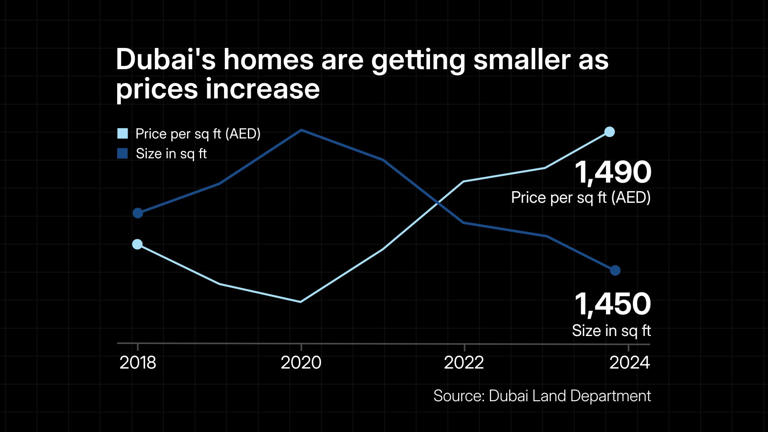
According to ValuStrat, using data from Dubai Land Department, the average home size has decreased to 1,450 square feet, while the average price per square foot has climbed to Dh1,490 ($405)—its highest level to date.
This shift highlights a growing demand for affordability amid rising property prices. Developers, faced with higher land and construction costs, are opting for more compact homes, leading buyers to focus on properties in prime locations, further contributing to this trend.
Multiple factors are influencing this change, including Dubai’s net-zero goal for 2050, spurring demand for energy-efficient and cost-effective housing. Additionally, rapid population growth since the 2020 pandemic has increased demand for affordable homes, with over 100,000 new residents arriving in 2023.
“Developers like Damac and Emaar noticed that many prospective buyers wanted to live in prime areas but couldn’t afford larger units,” noted Wassim Abdallah, head of off-plan at Betterhomes. “Rather than reducing prices, they minimized unit sizes to offer a more affordable entry point.”
In 2021, the average home size was 2,087 square feet, but there has since been a clear trend toward smaller units as prices per square foot continue to increase.
A recent report by Betterhomes indicated that long-term residency in Dubai is rising, with 89% of respondents planning to stay for more than five years, and 66% intending to remain for over a decade. This shift is prompting developers to prioritize functionality and affordability over space.
In 2024, the average home size is over 600 square feet smaller than three years ago, reflecting the market’s adaptation to rising costs and growing demand.
Dubai’s move towards smaller homes is common among other cities facing similar affordability challenges.
“A three-bedroom house remains a three-bedroom house, even if the rooms are smaller,” said Mario Volpi, real estate veteran and head of brokerage at Novvi Properties. “The strategy of building smaller houses seems effective, and ultimately, buyers can decide how to use the space.”