Dubai is witnessing a rise in multi-year rental agreements as more tenants plan to remain in the city long-term and aim to secure favourable lease conditions, according to a new study.
“Tenants appreciate the ability to fix their rent, which helps with financial planning, while landlords enjoy reduced turnover and fewer vacancy periods,” said Rupert Simmons, leasing director at real estate firm Betterhomes.
He added, “Long-term rental agreements reflect a maturing market and growing tenant stability.”
In the first quarter of 2025, payments made in one or two cheques rose by 10 per cent and 11 per cent, respectively, from the previous quarter, the report revealed.
This increase may be due to tenants seeking better lease deals in a competitive market, suggesting a rising number of higher-income individuals entering the rental space. While paying with multiple cheques is still common, those with larger budgets are often more flexible in their payment options, the study found.
Renewals continued to dominate the market, making up 64 per cent of all rental contracts in Q1—the highest share in a year. This indicates that many tenants prefer to stay within the rent index limits rather than face potentially higher rents in the open market.
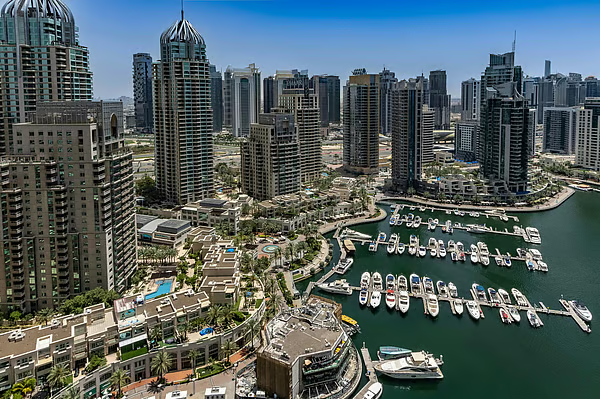
Top apartment rental locations included Dubai Marina, Jumeirah Lakes Towers, and Downtown Dubai. For townhouses, the most sought-after communities were The Springs, Dubai Hills Estate, and Tilal Al Ghaf, Betterhomes stated.
The strongest increase in demand was noted for townhouses, reflecting growing interest in this property type.
An increasing number of long-term renters are now turning to property ownership, driven by mortgage payments that are often lower than rental costs.
“In today’s climate, the cost gap between renting and buying is the smallest it’s ever been. With mortgage rates steady and property prices climbing, more buyers are choosing to convert rent into equity. Buying in Dubai is a smart financial step,” said Jeffrey De Souza, head of mortgages at Lomond.
To illustrate, a two-bedroom home in The Springs is generally priced around Dh3 million ($816,882). The Real Estate Regulatory Agency’s rental calculator suggests an annual rental range of Dh150,000 to Dh200,000.
A 25-year mortgage at 3.99% interest on a Dh3 million property would result in monthly payments of approximately Dh12,655, or about Dh151,860 annually—demonstrating that purchasing may be more cost-effective than renting.
Dubai’s real estate sector has also been buoyed by several government initiatives, including residency options for retirees and remote workers, the expansion of the 10-year golden visa scheme, and continued economic diversification in the UAE.
In the first quarter of 2025, the Dubai Land Department recorded 42,422 property sales transactions—up 23 per cent from the same period last year, although this marked a 10 per cent dip from the particularly strong final quarter of 2024. Off-plan sales played a major role, with 24,942 transactions—a 25 per cent yearly rise—comprising 59 per cent of all activity.
The total value of real estate deals in Q1 reached Dh114 billion, a 29 per cent increase year-on-year, according to DLD figures.
Apartment sales hit 32,237, a 14 per cent annual rise, with values climbing 12 per cent to Dh60.8 billion. Villas saw a 65 per cent jump in transactions to 10,185, with their total value increasing by 56 per cent to Dh53.4 billion.
“What’s significant is the growing shift toward end-users and buyers using mortgages, which shows strong faith in Dubai as a long-term living and investment destination,” said Christopher Cina, sales director at Betterhomes.
While 7,848 new units were completed in Q1 2025, data from Property Monitor shows that a large number of new homes are expected in the coming years, with nearly 97,000 units anticipated in 2026 alone.
“This large pipeline of upcoming supply will be crucial to watch, as it could impact both sale prices and rental rates depending on future demand,” the Betterhomes report noted.
New completions are projected to remain high through 2027 and 2028 before declining in 2029, the report added.