
Recent studies unveil the correlation between the use of reflective materials and the presence of abundant vegetation in reducing heat levels.
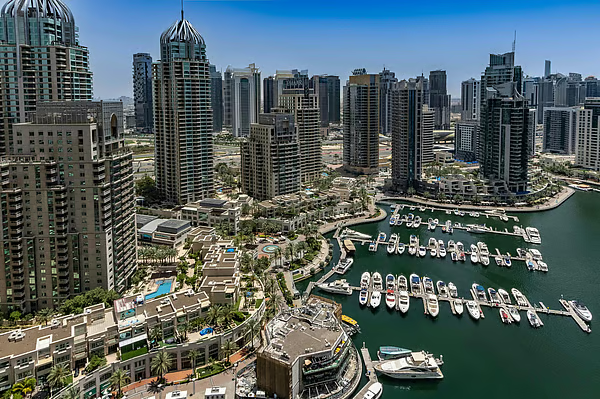
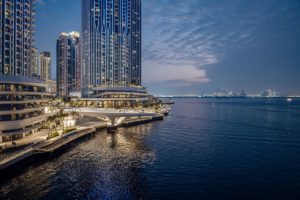
Jumeirah Lakes Towers, commonly referred to as JLT, is considered one of Dubai’s trendiest neighborhoods – and its appeal extends beyond its diverse range of restaurants, glistening waters, and towering structures. The neighborhood’s distinction lies in its well-thought-out design, particularly in how it incorporates abundant vegetation to mitigate temperature increases in the constant sunshine of the UAE.
JLT has garnered praise as a exemplary model of how a meticulously planned district can positively impact its residents. According to Dr. Ansar Khan, an assistant professor in the Department of Geography at the University of Calcutta in India, the area features ample green spaces, including landscaped parks and lakes. These elements play a vital role in reducing ambient temperatures by providing shading and facilitating evapotranspiration, where plants and the soil release water.
Reimagining city living

The study, as published in Energy and Buildings, highlights the impact of nearby structures, vegetation, and paving materials in the neighborhood on solar radiation absorption and reflection. Factors such as using reflective materials and incorporating abundant vegetation were shown to decrease a building’s energy demand for cooling by up to 36.4 percent.
This substantial reduction underscores the potential of combining increased vegetation and cool materials to address urban heat island effects and reduce energy consumption, particularly in extreme desert climates like Dubai downtown, according to Dr. Khan.
The findings emphasize the significance of adopting sustainable and innovative solutions to tackle challenges posed by urbanization and climate change. Dr. Khan suggests that integrating cool strategies into neighborhood designs during the planning stage is ideal, and developers could be incentivized to do so.
In existing areas, retrofitting measures, such as applying reflective coatings to roofs, can enhance resistance to heating. Planting trees, creating vegetation-covered green roofs, and installing green walls contribute to both reducing heating and enhancing air quality.
Dr. Khan emphasizes that involving residents and stakeholders in urban greening projects can enhance community resilience and create shared spaces that promote well-being and environmental sustainability.
Given that air conditioning accounts for up to 70 percent of the UAE’s electricity consumption, reducing energy use in cooling is crucial. World Bank figures reveal a five-fold increase in the energy used for cooling internal spaces in the Middle East from 25 terawatt hours to 125 terawatt hours between 1990 and 2016. Projections from the World Bank indicate a threefold increase in the number of air conditioning units globally by the middle of the century.
Why JLT is leading the way

In JLT, alongside its parks and lakes, the architectural design of the buildings serves to minimize heating, as highlighted by Dr. Khan.
“Numerous buildings in Jumeirah Lakes Towers are equipped with state-of-the-art cooling technologies and energy-efficient designs, including insulated facades and reflective surfaces.
“These elements collaborate to reduce heat absorption and diminish the need for excessive air conditioning, ultimately lowering the overall demand for cooling energy,” he explained.
“Jumeirah Lakes Towers exemplifies a well-planned Dubai neighborhood that effectively incorporates scientific cooling strategies into its urban design, establishing a standard for sustainable and comfortable living in the challenging desert climate,” he added.
This recent study is the latest in a series illustrating alternative methods for achieving cooling without solely relying on air conditioning.
In December, researchers from the University of Sharjah demonstrated that, with improved shading, ventilation, and insulation, air conditioning demand in a two-storey, three-bedroom villa could be reduced by 40 percent.
Furthermore, a 2022 study revealed that traditional UAE neighborhoods, like Al Fahidi in Dubai, characterized by high building density, tend to be cooler during peak daytime heat than certain more modern areas, such as the low-rise sections of Jumeirah.
Two contributing factors to Al Fahidi’s coolness include its greater building height-to-width ratio in comparison to Jumeirah and its lower sky view factor, indicating less visible sky from the ground.