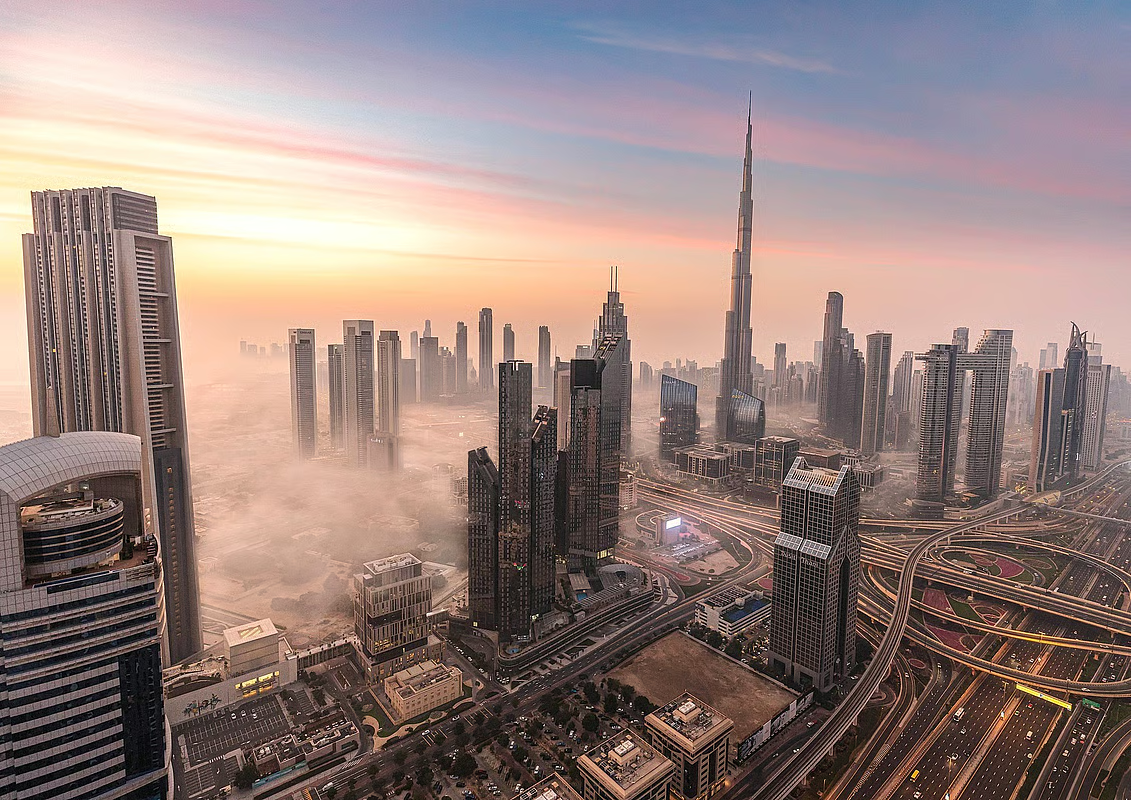

The emirate possesses enough strength to overcome economic challenges due to surging demand expected to surpass supply, along with government incentives and a state-of-the-art infrastructure.
Dubai’s real estate market maintains its lead over global hubs like New York, London, and Hong Kong, showing no signs of slowing down. Experts predict that property prices and rents in the emirate will keep rising in 2025, despite the recent record rainfall and subsequent flooding, which had only a “minimal” impact on the realty market.
Amidst global economic fluctuations, experts informed Al Arabiya English that property prices in Dubai are expected to increase by five to seven percent annually in both 2024 and 2025, fueled by a surge in demand that exceeds available supply.
Aran Lomax, managing partner of TREO homes, asserts, “Throughout history, Dubai’s property market has demonstrated resilience and sustained expansion, notwithstanding periodic fluctuations. The market’s growth appears poised to persist unabated, fueled by escalating demand stemming from an influx of residents into Dubai and government-led development initiatives.
“Recent data from 2023 highlights Dubai’s ascendancy as the top destination for high-value property transactions, surpassing renowned real estate hubs like New York, London, and Hong Kong.”
Floods to have ‘minimal impact on prices’
Zarah Evans, proprietor and managing partner at Exclusive Links Real Estate Broker, remarked that despite the recent floods affecting some homes in the UAE, resulting in submersion and water damage, the demand for property is unlikely to decrease.
“The recent floods in Dubai might temporarily decrease interest in certain communities most affected by the heavy rainfall, but this effect is expected to be short-lived,” she informed Al Arabiya English. “Dubai has a history of swiftly responding positively to challenges, and this was evident right after the rain.”
She added, “Upgrades to the drainage system were being announced by the government, with developers also offering residents complimentary repairs for any damages. In moments like these, Dubai, as a united community, demonstrates resilience, and any price adjustments will quickly recover.”
Affordability and opportunity
Lomax notes that Dubai stands out for offering exceptional value to buyers compared to other global cities, providing much more space for less money. In Dubai, $1 million buys 980 sq.ft., while in London, New York, Los Angeles, Singapore, and Sydney, it only buys 355 sq.ft., 366 sq.ft., 409 sq.ft., 344 sq.ft., and 462 sq.ft. respectively.
In addition to spacious properties, Dubai’s appeal lies in its strategic location, business-friendly policies, diversity, and safety. According to Lomax, nowhere else in the world offers the lifestyle, diversity, and opportunities that Dubai does while maintaining such high levels of safety and convenience.
Hussain Sajwani, Founder and Chairman of DAMAC, told Al Arabiya English that while predicting the future is uncertain, almost all key economic indicators suggest a healthy growth rate for Dubai’s real estate sector. He emphasized robust transaction levels across all major developments, sustained demand, and the success of launching over 20 projects last year as reflections of confidence in Dubai’s market, largely unaffected by external factors.
Surging population growth fuels demand
Dubai is projected to reach a population of 5.8 million by 2040, requiring around 54,440 new homes annually to meet demand, not even factoring in tourism growth.
Evans noted, “Despite numerous launches in 2023, the city’s population is expanding at a rate 300 percent faster. Soon, Emaar, Damac, and Majid Al Futtaim will introduce four new mega projects to address the shortage of villas and townhouses.”
Evans also highlighted the delay between project launch and handover, which currently impacts the availability of ready homes and contributes to rising rental prices.
The statistics vividly illustrate the pressing housing shortage.
New developments
Damac Hills is expanding its community in Dubai with contemporary villas ranging from 3 to 7 bedrooms and offering various amenities. Mohammed Bin Rashid Al Maktoum City’s District 11 is introducing spacious villas with park views, available in configurations of 3 to 5 bedrooms. The Valley by Emaar is introducing a picturesque town featuring villas with 3 to 5 bedrooms, along with a beach, park, and sports village set amidst the desert landscape.
The Oasis presents over 7,000 units and four golf courses, featuring villas with 4 to 5 bedrooms starting at $2.2 million. Dubai South’s residential district offers semi-detached villas and mansions with 3 to 7 bedrooms. Rukan Community by Continental Investments is on track to deliver 1,299 family villas by December.
Jewel of the Creek has introduced 1,260 new apartments in its creekside development. Aura in Tilal Al Ghaf will deliver 808 resort-style villas with 3 to 4 bedrooms in May. In Business Bay, Regalia Residences aims to deliver 900 new apartments, ranging from studios to penthouses, by December.
Government initiatives drive growth
The remarkable performance of Dubai’s real estate sector has been significantly influenced by the proactive policies and ambitious infrastructure projects spearheaded by the government. Recent reforms in visa regulations, such as the relaxed criteria for the Golden Visa, have greatly benefited prospective buyers.
According to Evans, factors such as government initiatives, financial transparency, cutting-edge facilities, and infrastructure are all instrumental in driving interest in Dubai’s property market. Moreover, the real estate industry is evolving towards greater maturity and transparency, fostering stronger connections with established markets like Europe, the US, and Australia, while enjoying the advantage of being exempt from property taxes.
Dubai’s strategic position as a hub for trade and tourism makes it susceptible to global economic shifts; however, its demographics, thriving economy, and resilient spirit continue to position it favorably, ensuring sustained growth and prosperity.
Evans emphasizes that visa initiatives are also playing a significant role in energizing the property market.
The recent announcement of the relaxed Golden Visa, which eliminates the minimum down payment requirement in the UAE, has further spurred interest among buyers.
Being a tax haven is another significant attraction. “Dubai’s absence of property taxes undoubtedly positions it as one of the most desirable investment destinations when compared to other cities,” Evans observes.
The continual expansion of the city’s infrastructure and amenities also propels demand and drives prices higher.
“Naturally, demand for properties will keep rising as we witness the city expanding its infrastructure and amenities,” Evans remarks. “The development of new transportation links, entertainment venues, and business prospects will continue to fuel property demand and push prices upward.”
Evans also notes that Dubai isn’t just making waves in property headlines but is also setting benchmarks in technology and cutting-edge infrastructure. Dubai consistently shares its vision and proudly introduces ‘the biggest and the best,’ ensuring sustained long-term interest and viability.
Sajwani highlights several factors contributing to Dubai’s real estate sector success and growth.
“Among these factors, the measures implemented during the COVID-19 pandemic and regulatory reforms supporting investment and residency laws have significantly impacted Dubai’s global perception. Expatriates who historically resided here opted to purchase their first homes in Dubai during the pandemic. Investors from various markets have also recognized Dubai’s potential as a haven for their investments and as a base for their businesses.”
Over the years, Dubai has intentionally transformed from a trading hub into a knowledge economy and eventually into a hub for innovative industries, according to Sajwani.
“This draws businesses and individuals with disposable income and a substantial portion of global wealth to consider establishing their headquarters and residences in the city. The consistent efforts of the city’s leadership to focus on future sectors have been pivotal in its resilience over time.”
“The primary differentiator for Dubai has been the inclusive leadership, which not only provides avenues for public-private partnerships but also fosters the success of private enterprises by continuously enhancing the built environment and infrastructure, thus future-proofing the city. DAMAC aligns its projects with Dubai’s vision to provide residents from all segments access to thriving communities.”
“The decisive actions following the leadership’s vision, such as the Dubai Plan 2021 prioritizing people’s happiness and quality of life, and now the Dubai 2040 Urban Master Development framework, complement developmental efforts across public and private sectors. These examples illustrate the government’s holistic approach, backed by detailed implementation, fostering enduring confidence in Dubai.”
Emerging Trends: Sustainability, luxury, branded residences
Lomax predicts that Dubai will increasingly prioritize sustainability as its property market evolves, with a particular emphasis on eco-friendly development.
Evans highlights Dubai’s commitment to sustainable urban development, noting that government policies since the early 2000s have promoted environmentally friendly construction practices, leading to an influx of innovative building technologies and making Dubai a center for cutting-edge sustainable architecture.
He also observes that the adoption of the Dubai Green Building Regulations and Specifications in 2010 has spurred the construction of more green buildings, enhancing competitiveness among developers and ensuring their long-term success and viability. Green buildings typically command higher rental and resale values than traditional ones, providing added returns on investment.
Additionally, Evans notes that the COVID-19 pandemic has reshaped consumer preferences, resulting in increased demand for green spaces and home offices. Developers have responded by incorporating these features into their projects, along with releasing more ultra-luxurious housing to cater to higher incomes and Dubai’s global reputation.
Evans highlighted the current trends, emphasizing the growing importance of smart technology in homes. Developers are actively pursuing mixed-use projects, integrating residential, commercial, retail, and green recreational spaces to promote health and wellness. Notably, the expansion of crystal blue lagoons in desert landscapes and the redevelopment of Dubai’s beachfront, such as Palm Jebel Ali, are prominent features. Luxury branded residences, developed through partnerships with prestigious brands, are also on the rise. Developers like Omniyat are collaborating with renowned architects such as Zaha Hadid, Foster + Partners, and Gilles & Bossier to create exceptional living spaces in Dubai. For instance, Armani Beach Residences Palm Jumeirah by Tadao Ando and Arada exemplifies this trend. Despite the focus on luxury, addressing affordability remains a crucial goal for developers.
Evolving with the times
Demographic shifts and evolving lifestyle preferences following the pandemic are also shaping demand patterns.
Lomax has noted a rising trend among residents who now regard Dubai as a permanent residence rather than a temporary location.
“Previously, Dubai was characterized by its transient population, with few residents considering it as a place for long-term settlement.
However, since the onset of the pandemic, there has been a noticeable shift in public sentiment, with more people now viewing Dubai as their permanent home for the first time. This shift has been bolstered by initiatives such as the government’s Golden Visa program, along with policies that are more conducive to businesses and freelancers, as well as lower interest rates, providing residents with greater opportunities to purchase homes, a choice that was predominantly limited to renting,” explained Lomax.
An unstoppable upward trajectory?
As Dubai anticipates the period beyond 2025, the remarkable ascent of its market seems set to persist, albeit potential challenges loom on the distant horizon.
“Looking forward, the cyclical trends suggest a potential oversupply scenario, which may lead to price decreases. Presently, we witness an average of one new launch every 18 hours, satisfying investors’ demand, yet this level of activity may eventually contribute to an oversupply situation,” Evans remarked, noting that Dubai’s real estate growth saga, though, remains unabated.
“Dubai continues to allure both local and international property investors with appealing returns, progressive policies, and its status as a safe haven. Not only is Dubai experiencing an increase in its resident population, but also in tourism, distinguishing itself globally and benefiting from its appeal as a playground for the affluent.”
“Both capital appreciation and rental returns remain robust compared to other global markets, and despite the uptick in prices and interest rates in Dubai, we observe a shift as tenants transition into buyers,” she elaborated.